
EVGA GeForce GTX 1060 3GB FTW GAMING ACX 3.0, 3GB GDDR5, LED, DX12 OSD Support Graphic Cards 03G-P4-6168-KR
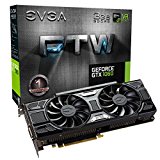
- Real Base Clock: 1620 MHz / Real Boost Clock: 1847 MHz; Memory Detail: 3072MB GDDR5
- Run Longer, Play Longer with EVGA “ACX 3.0” Cooling
- What you see is what you get! – No additional software required to achieve listed clock speeds
- DX12 OSD Support with EVGA Precision XOC
- 3 Year Warranty & EVGA’s 24/7 Technical Support
The EVGA GeForce GTX 1060 graphics card is loaded with innovative new gaming technologies, making it the perfect choice for the latest high definition games. Powered by NVIDIA Pascal, the most advanced GPU architecture ever created, the GeForce GTX 1060 delivers brilliant performance that opens the door to virtual reality and beyond. These cards also feature EVGA ACX 3.0 cooling technology. EVGA ACX 3.0 once again brings new and exciting features to the award winning EVGA ACX cooling technology. SHP gives increased heat pipes and copper contact area for cooler operation, and optimized fan curve for even quieter gaming. Of course, ACX 3.0 coolers also feature optimized swept fan blades, double ball bearings and an extreme low power motor, delivering more air flow with less power, unlocking additional power for the GPU.

List Price: $ 239.99
Price:
Single VS Twin Fan. You Really Don’t “Need” More Than This,
If you are as curious as I was to what the difference of single vs twin fan cards are, I found the simple answer browsing some PC build forums.
Basically, a lot of it boils down to looks, and the rest is how far you can overclock past stock.
-PC enthusiasts love beefy, expensive looking cards and equipment to fill out their towers, and twin cards deliver with their bigger case, lights, and backplate. Single fans don’t have any of that, but are cheaper as a result.
-Single fan cards also don’t stand up to overclocking as much as twin fans because of heat dissipation. That’s not to say single fans aren’t adequate out of the box. If you don’t plan on overclocking, a single fan is just fine and will never overheat.
You really don’t need a twin fan model, or really anything above a 1060 if you’re a basic gamer that doesn’t care about looks and just wants a high performance card you don’t plan on messing with. I’m playing on a 144mhz monitor and get 160FPS playing Overwatch on Ultra, and about 100 on Epic. TF2 is beyond easy to play at max and Subnautica looks absolutely beautiful on topped out graphics with no stuttering. My tower is in a somewhat confined space as well and the card has never overheated even in 5+ hours of non-stop gaming.
UPDATE: I downloaded the “Precision X” Bios from EVGA and updated the card. It’s now faster then ever. Even on stock tune and no overclocking the card is now peaking at 2012mhz, WAY higher than advertised and higher than any stock clocked 1060 on the market. I’m loving this card more every day.
Was this review helpful to you?

|Amazing card with some caveats,
As an example, this card can render Witcher 3 on ultra settings at around 60FPS with no stuttering and the colors look great. This card is paired with a i5-4690 3.5 GHz processor and 16 GB GSkill Ripjaws.
It does have some limitations that the 960 didn’t have.
1. It has a single DVI port, and not the format that allows for DVI->VGA, so if you have a VGA monitor, you will be out of luck here. DP or HDMI to DVI is not an issue so if you have two DVI or HDMI monitors, at worst you will need an adapter. It also only has 1 HDMI, but again there are adapters for that.
2. No SLI connections. I suspect this was done because two of these would probably be equal or better of a single 1070 and possibly 1080. I don’t know for sure, but it is the most likely explanation in my opinion because the extra cost over the 960 pretty much covers the additional RAM on board.
One big annoyance, and I don’t know if it is the fault of Nvidia or EVGA or not their fault at all, but you can not change the display order in the BIOS. It goes DVI->HDMI->DP. When I bought this I replaced one of my monitors with a DP monitor and I use that as my primary screen. The BIOS screen on boot up and GRUB2 menu would always display on the secondary monitor. That is annoying but doesn’t affect anything once you are booted into an operating system where you can choose what monitor is the primary. A small DVI to DP adapter solved it without issue. I don’t know if this has always been this way since I used to only have DVI monitors so I don’t want to ding the rating for something that might be normal.
Was this review helpful to you?

|