Kingdom Hearts 3D Dream Drop Distance
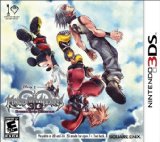
- Dual protagonists – Play as the two most popular characters of the franchise, Sora and Riku
- “Free-flow” action – Enjoy fast and effortless movements while interacting with the environment and performing acrobatic attacks
- Brand-new creatures – Dream Eaters inhabit the Sleeping Worlds, and are split into two categories: Spirits and Nightmares. Recruit over 50 different types of Spirits as allies to fight alongside Sora and Riku
- New Disney worlds – Beloved Disney worlds and characters, such as La Cité des Cloches (The Hunchback of Notre Dame), make their series debut
- Story progression – With updated looks for Sora and Riku, and the impending conflict made clear, this title is a big step forward in the series
King Mickey and Yen Sid prepare for an impending threat by putting Sora and Riku through the Mark of Mastery exam. Sora and Riku are sent into the Sleeping Worlds, where they will face enemies and allies that have never been seen before. If they can successfully complete the task they are given, they will be deemed true Keyblade Masters.

List Price: $ 29.99
Price:


|
171 of 186 people found the following review helpful
 Square Enix’s Redemption, By
Elias (Nowhere In Particular) – See all my reviews
This review is from: Kingdom Hearts 3D Dream Drop Distance (Video Game)
I’ve been a fan of the “Kingdom Hearts” franchise for a while, but even the most devout followers have begun to grow weary of its publisher’s practice of shelling out prequels, in-between-quels, and all-over-the-place-quels. In all of these games, the gameplay remains fundamentally unchanged, with the exception of “Re:Coded”, which was otherwise a disappointment in my book. It seemed that, on the surface, Square Enix was simply jumping on the 3DS bandwagon and shelling out another half-baked entry in order to stall before people tore down their door and demanded Kingdom Hearts III already. Regardless, I decided to give this the benefit of the doubt, and I’m pleased to announce that this is the best game in the series since “KHII”. In fact, it may arguably be the best entry yet. We join Sora and Riku after the events of II and “Re:Coded”. Riku is playing for the good guys again, teaming up with Sora to take on the Mark of Mastery exam. This involves them travelling to various worlds in order to find hidden keyholes that will prove their meddle as true Keyblade Masters. The plot is a welcome change of pace from the treacly sentimentality of “358/2 Days”, the rehashed narrative in “Birth By Sleep”, and the confused logic and pacing of “Re:Coded.” Nomura and all others involve certainly listened to the critics when it came to the story in this entry, and gave us what we wanted: a true follow-up. Much in the vein of “Chain of Memories”, “Dream Drop Distance” expands on world of the game without losing its focus, and never gets lost trying to pander to fans. The result is the most focused game yet, and one whose story is filled with enough emotion and excitement for any gamer to enjoy. That being said, it’s best to be familiar with the franchise before tackling this one. Newcomers may feel a little bit lost. My main concern about “DDD” was definitely the gameplay, given that it hasn’t really changed in several years. All fears have been put to rest now, due to the fact that the dev team definitely took their time with making a fun and balanced experience. The level-based hack-n-slash we’re used to is still here, but it’s aided by the addition of a new system called “Flowmotion.” This is a snazzy way of saying that Sora and Riku now fancy themselves to be masters of parkour. The real surprise here is that Square Enix managed to slide in a new gameplay feature without turning it into a convoluted wreck. Flowmotion works fabulously. Within a few minutes of playing, you’ll be grinding off of rails, using enemies as pommel horses, and careening off walls hundreds of feet in the air. Doing this allows you to deliver devastating special moves on enemies. Every enemy encounter, and especially every boss stage, transcends typical button-mashing battles and turns into something more visceral and downright fun than I ever expected from this franchise. The other addition is the “Drop” feature. You’ll be playing as both Sora and Riku in this game, as they battle through parallel worlds to find the hidden keyholes. This works in a very unique way; you have a time with each character, as they experience different narratives in the same worlds. You have to beat the world with both characters in order to truly beat it and progress the story. This is less cumbersome than it sounds, and is in fact a very interesting way to approach handling both characters. You can also jump to another character early by using the “Drop” button on the pause menu. This can be handy if you get to a good stopping point in one character’s progression. Getting to experience both characters’ unique perspectives is a welcome change in pace for the series. Another worth mentioning, if only for a few sentences, is the addition of Spirit companions. Much like the world-specific partners of previous games, these animals fight side-by-side with you and can be teamed up with for a special attack. However, it works in a similar fashion to the “Shin Megami Tensei”, where you collect certain components of the monsters, then combine them in order to create them. Depending on how many components you have, you can alter the strength and abilities of the monsters. You can have three with you at any given time, and I highly recommend you do so. These partners are very helpful, and fun to customize and level up. The interface for leveling them is very similar to a virtual pet simulator by way of “Final Fantasy X”‘s level system. It’s not too complicated, but not overly simplistic. Just the right balance of strategy and fun make this a worthwhile component to an already great game. Graphically, this is the best-looking game in the series, without a doubt. Having played several 3DS titles, I can firmly say this is the prettiest one yet, and clearly demonstrative of what we can expect from Square Enix in the near future. Environments pop to life with dazzling use of textures and shadows, and everything blazes forward…
16 of 16 people found the following review helpful
A Return to Form For Kingdom Hearts, and A Good Set Up to 3, By
Verified Purchase(What’s this?)
This review is from: Kingdom Hearts 3D Dream Drop Distance (Video Game)
One of the best things I can say about the 3DS is that the hardware is amazing, allowing for a handheld gaming experience equivalent to a slightly scaled back PS2 game. This all works in 3D’s favor, as it provides fans with an experience not held back by hardware limitations like the DS games were, and provides a similar feeling to the original 2 games as well as Birth By Sleep. The confusingly named Kingdom Hearts 3D Dream Drop Distance has to deal with a powerful goal: combining the huge cluster storm of a story that has been told in the previous handheld games, and somehow tie them all together, while setting up the highly anticipated third installment in the series, no matter if it has to use multi-layered storytelling, insistent terminology of its mythology, and ret-cons. Loads and loads of ret-cons. 3D takes place after Kingdom Hearts 2, and follows directly after the secret ending of re:Coded. Sora, Riku and the gang have to deal with the fact that (spoiler alert) Xehanort is coming back. To prepare, Master Yen Sid has Sora and Riku take what is known as the Mark of Mastery exam. Unlike the one seen in BBS, however, this is different. Sora and Riku must travel to 7 Sleeping Worlds, worlds that have returned after being attacked by Heartless but are still in a "sleeping state." In order to do this, they must enter a dream state themselves. Things get… complicated, to say the least, and eventually Riku and Sora are split up and they find themselves encountering old foes and an even bigger plan than they thought. 3D takes what was already a complicated story and makes it even more complicated. New elements are introduced to advance the story, but as a result end up complicating previous events in the story to make it work. The overall result is something very confusing. Luckily, the developers realized this, and they added flashbacks and journal entries that summarize all the previous games, just in case there was something you missed. For the most part, they’re not bad, and they do an okay job, but the problem I seem to have is that they never really get into the terminology and definition of the previous games. What exactly are nobodies? Why are memories so important? What is all this talk about hearts and the X-blade? It does an okay job, and by the end I’m sure you’ll understand, but it’s still something worth noting. Furthermore, most of the important story exposition is reserved for the very end, meaning a massive amount of the story is spent trying to figure out exactly what’s going on, and then the end is spent trying to make sense of all this new info you’ve acquired. If I’m making it sound like I dislike the story of 3D, I apologize, as I actually really like the story, especially near the end, when everything comes together. It introduces new elements, advances and develops our protagonists in believable and natural ways, and makes the stakes actually feel severe, which is a problem a lot of recent (ex: re:Coded) Kingdom Hearts seemed to have. It gives a lot to work with for the third game, and makes me excited to see the path they go down. Gameplay wise, there’s very little to complain about. It’s Kingdom Hearts. It plays like Kingdom Hearts. It uses a slightly simplified command deck system from BBS. Keyblade upgrades are the same. Kingdom Hearts 3D is different in two matters, however: Flowmotion and the Dreameater system. Flowmotion is similar to the reaction commands from 2, but with more emphasis on movement and (as the name implies) flow rather than a button that just lets you do cool things. Flowmotion is an interesting idea itself, but I found that the more I continued playing the game, the less I used it. Getting stuck in Flowmotion makes you more vulnerable to enemy attack. It’s main benefit is that it’s a quick way to do some damage, but it won’t do you much good if you get killed before you finish it. The Dreameater system seems to be this game’s replacement for Donald and Goofy, as well as a mix of a Pokemon/Nintendogs system. Basically, throughout the game you gather supplies and recipes to create dream eater companions, each with their own set of skills and inevitable cuteness. With these, they can fight with you, heal you, and do special limit attacks similar to the Drive forms from 2 in a way. Also included is a mode where you can play VR games and have a giant petting session with your Spirit Dreameater. They’re very interesting ideas, and maybe it’s just because I didn’t play the game right, but it sort of seems superfluous in a way. I couldn’t really see any benefit to participating in it, and for the most part I didn’t have the desire to. My main focus in the game was Kingdom Hearts, not the Nintendogs system that comes with it. Then again, to each their own. I’m sure there’s some that love it and really got into it, and it’s really a rather well made gamemode, but it just wasn’t…
30 of 35 people found the following review helpful
One of the best Kingdom Hearts games yet, By
Samuel Havron (Virginia, USA) – See all my reviews
This review is from: Kingdom Hearts 3D Dream Drop Distance (Video Game)
Kingdom Hearts 3D [Dream Drop Distance] is an amazing game in nearly every way. There are a whole lot of things to do while on your adventure, and the worlds are large and full of places to explore.
The story is still as complicated as usual, but it’s a great one that really sets the tone for Kingdom Hearts 3. If you’ve never played a Kingdom Hearts game before (or just need a refresh on the story), this game has cutscenes and readable reports that fill you in from the very beginning. New gameplay elements to the series, such as flowmotion and the drop system, are intuitive and really make the game great. Flowmotion makes moving on the field, whether in battle or not, a much easier and more enjoyable experience. The drop system is a clever pacing tool that keeps you interested in both Sora and Riku’s respective stories throughout the game. In addition, the command board and abilities make a welcome return here. In battle, Sora and Riku have partners that are creatures called spirits, and they are one of the two types of Dream Eaters. There are over 50 different kinds of spirits, and as such they are quite varied in size, shape, and fluffiness. There are a lot of things you can do with a spirit that influences their stats and even their affection for Sora or Riku; for instance, you can pet, feed, and play with them in similar vein to the Nintendogs games. The second type of Dream Eater is called a nightmare; the various types of nightmares are Sora and Riku’s main enemy throughout the game. Depending on the difficulty level you choose at the beginning of the game, nightmares can be easy or more difficult to defeat. The sound system in the game is noticeably more high spirited and festive than other entries in the series, but this is not a bad thing. Classic Kingdom Hearts tracks such as Hand in hand and Dearly Beloved make a return, while new songs still keep to the original feel of the games. My personal favorite track in the game is Traverse in Trance. Overall, Kingdom Hearts 3D [Dream Drop Distance] is clearly one of the series’ best, and one of my all time favorite video games. |




Square Enix’s Redemption,
I’ve been a fan of the “Kingdom Hearts” franchise for a while, but even the most devout followers have begun to grow weary of its publisher’s practice of shelling out prequels, in-between-quels, and all-over-the-place-quels. In all of these games, the gameplay remains fundamentally unchanged, with the exception of “Re:Coded”, which was otherwise a disappointment in my book. It seemed that, on the surface, Square Enix was simply jumping on the 3DS bandwagon and shelling out another half-baked entry in order to stall before people tore down their door and demanded Kingdom Hearts III already. Regardless, I decided to give this the benefit of the doubt, and I’m pleased to announce that this is the best game in the series since “KHII”. In fact, it may arguably be the best entry yet.
We join Sora and Riku after the events of II and “Re:Coded”. Riku is playing for the good guys again, teaming up with Sora to take on the Mark of Mastery exam. This involves them travelling to various worlds in order to find hidden keyholes that will prove their meddle as true Keyblade Masters. The plot is a welcome change of pace from the treacly sentimentality of “358/2 Days”, the rehashed narrative in “Birth By Sleep”, and the confused logic and pacing of “Re:Coded.” Nomura and all others involve certainly listened to the critics when it came to the story in this entry, and gave us what we wanted: a true follow-up. Much in the vein of “Chain of Memories”, “Dream Drop Distance” expands on world of the game without losing its focus, and never gets lost trying to pander to fans. The result is the most focused game yet, and one whose story is filled with enough emotion and excitement for any gamer to enjoy. That being said, it’s best to be familiar with the franchise before tackling this one. Newcomers may feel a little bit lost.
My main concern about “DDD” was definitely the gameplay, given that it hasn’t really changed in several years. All fears have been put to rest now, due to the fact that the dev team definitely took their time with making a fun and balanced experience. The level-based hack-n-slash we’re used to is still here, but it’s aided by the addition of a new system called “Flowmotion.” This is a snazzy way of saying that Sora and Riku now fancy themselves to be masters of parkour. The real surprise here is that Square Enix managed to slide in a new gameplay feature without turning it into a convoluted wreck. Flowmotion works fabulously. Within a few minutes of playing, you’ll be grinding off of rails, using enemies as pommel horses, and careening off walls hundreds of feet in the air. Doing this allows you to deliver devastating special moves on enemies. Every enemy encounter, and especially every boss stage, transcends typical button-mashing battles and turns into something more visceral and downright fun than I ever expected from this franchise.
The other addition is the “Drop” feature. You’ll be playing as both Sora and Riku in this game, as they battle through parallel worlds to find the hidden keyholes. This works in a very unique way; you have a time with each character, as they experience different narratives in the same worlds. You have to beat the world with both characters in order to truly beat it and progress the story. This is less cumbersome than it sounds, and is in fact a very interesting way to approach handling both characters. You can also jump to another character early by using the “Drop” button on the pause menu. This can be handy if you get to a good stopping point in one character’s progression. Getting to experience both characters’ unique perspectives is a welcome change in pace for the series.
Another worth mentioning, if only for a few sentences, is the addition of Spirit companions. Much like the world-specific partners of previous games, these animals fight side-by-side with you and can be teamed up with for a special attack. However, it works in a similar fashion to the “Shin Megami Tensei”, where you collect certain components of the monsters, then combine them in order to create them. Depending on how many components you have, you can alter the strength and abilities of the monsters. You can have three with you at any given time, and I highly recommend you do so. These partners are very helpful, and fun to customize and level up. The interface for leveling them is very similar to a virtual pet simulator by way of “Final Fantasy X”‘s level system. It’s not too complicated, but not overly simplistic. Just the right balance of strategy and fun make this a worthwhile component to an already great game.
Graphically, this is the best-looking game in the series, without a doubt. Having played several 3DS titles, I can firmly say this is the prettiest one yet, and clearly demonstrative of what we can expect from Square Enix in the near future. Environments pop to life with dazzling use of textures and shadows, and everything blazes forward…
Read more
Was this review helpful to you?

|A Return to Form For Kingdom Hearts, and A Good Set Up to 3,
One of the best things I can say about the 3DS is that the hardware is amazing, allowing for a handheld gaming experience equivalent to a slightly scaled back PS2 game. This all works in 3D’s favor, as it provides fans with an experience not held back by hardware limitations like the DS games were, and provides a similar feeling to the original 2 games as well as Birth By Sleep.
The confusingly named Kingdom Hearts 3D Dream Drop Distance has to deal with a powerful goal: combining the huge cluster storm of a story that has been told in the previous handheld games, and somehow tie them all together, while setting up the highly anticipated third installment in the series, no matter if it has to use multi-layered storytelling, insistent terminology of its mythology, and ret-cons. Loads and loads of ret-cons.
3D takes place after Kingdom Hearts 2, and follows directly after the secret ending of re:Coded. Sora, Riku and the gang have to deal with the fact that (spoiler alert) Xehanort is coming back. To prepare, Master Yen Sid has Sora and Riku take what is known as the Mark of Mastery exam. Unlike the one seen in BBS, however, this is different. Sora and Riku must travel to 7 Sleeping Worlds, worlds that have returned after being attacked by Heartless but are still in a “sleeping state.” In order to do this, they must enter a dream state themselves. Things get… complicated, to say the least, and eventually Riku and Sora are split up and they find themselves encountering old foes and an even bigger plan than they thought.
3D takes what was already a complicated story and makes it even more complicated. New elements are introduced to advance the story, but as a result end up complicating previous events in the story to make it work. The overall result is something very confusing. Luckily, the developers realized this, and they added flashbacks and journal entries that summarize all the previous games, just in case there was something you missed. For the most part, they’re not bad, and they do an okay job, but the problem I seem to have is that they never really get into the terminology and definition of the previous games. What exactly are nobodies? Why are memories so important? What is all this talk about hearts and the X-blade? It does an okay job, and by the end I’m sure you’ll understand, but it’s still something worth noting. Furthermore, most of the important story exposition is reserved for the very end, meaning a massive amount of the story is spent trying to figure out exactly what’s going on, and then the end is spent trying to make sense of all this new info you’ve acquired.
If I’m making it sound like I dislike the story of 3D, I apologize, as I actually really like the story, especially near the end, when everything comes together. It introduces new elements, advances and develops our protagonists in believable and natural ways, and makes the stakes actually feel severe, which is a problem a lot of recent (ex: re:Coded) Kingdom Hearts seemed to have. It gives a lot to work with for the third game, and makes me excited to see the path they go down.
Gameplay wise, there’s very little to complain about. It’s Kingdom Hearts. It plays like Kingdom Hearts. It uses a slightly simplified command deck system from BBS. Keyblade upgrades are the same. Kingdom Hearts 3D is different in two matters, however: Flowmotion and the Dreameater system.
Flowmotion is similar to the reaction commands from 2, but with more emphasis on movement and (as the name implies) flow rather than a button that just lets you do cool things. Flowmotion is an interesting idea itself, but I found that the more I continued playing the game, the less I used it. Getting stuck in Flowmotion makes you more vulnerable to enemy attack. It’s main benefit is that it’s a quick way to do some damage, but it won’t do you much good if you get killed before you finish it.
The Dreameater system seems to be this game’s replacement for Donald and Goofy, as well as a mix of a Pokemon/Nintendogs system. Basically, throughout the game you gather supplies and recipes to create dream eater companions, each with their own set of skills and inevitable cuteness. With these, they can fight with you, heal you, and do special limit attacks similar to the Drive forms from 2 in a way. Also included is a mode where you can play VR games and have a giant petting session with your Spirit Dreameater. They’re very interesting ideas, and maybe it’s just because I didn’t play the game right, but it sort of seems superfluous in a way. I couldn’t really see any benefit to participating in it, and for the most part I didn’t have the desire to. My main focus in the game was Kingdom Hearts, not the Nintendogs system that comes with it. Then again, to each their own. I’m sure there’s some that love it and really got into it, and it’s really a rather well made gamemode, but it just wasn’t…
Read more
Was this review helpful to you?

|One of the best Kingdom Hearts games yet,
The story is still as complicated as usual, but it’s a great one that really sets the tone for Kingdom Hearts 3. If you’ve never played a Kingdom Hearts game before (or just need a refresh on the story), this game has cutscenes and readable reports that fill you in from the very beginning.
New gameplay elements to the series, such as flowmotion and the drop system, are intuitive and really make the game great. Flowmotion makes moving on the field, whether in battle or not, a much easier and more enjoyable experience. The drop system is a clever pacing tool that keeps you interested in both Sora and Riku’s respective stories throughout the game. In addition, the command board and abilities make a welcome return here.
In battle, Sora and Riku have partners that are creatures called spirits, and they are one of the two types of Dream Eaters. There are over 50 different kinds of spirits, and as such they are quite varied in size, shape, and fluffiness. There are a lot of things you can do with a spirit that influences their stats and even their affection for Sora or Riku; for instance, you can pet, feed, and play with them in similar vein to the Nintendogs games.
The second type of Dream Eater is called a nightmare; the various types of nightmares are Sora and Riku’s main enemy throughout the game. Depending on the difficulty level you choose at the beginning of the game, nightmares can be easy or more difficult to defeat.
The sound system in the game is noticeably more high spirited and festive than other entries in the series, but this is not a bad thing. Classic Kingdom Hearts tracks such as Hand in hand and Dearly Beloved make a return, while new songs still keep to the original feel of the games. My personal favorite track in the game is Traverse in Trance.
Overall, Kingdom Hearts 3D [Dream Drop Distance] is clearly one of the series’ best, and one of my all time favorite video games.
Was this review helpful to you?

|