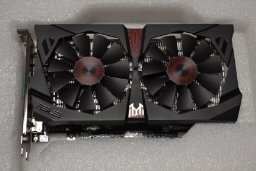
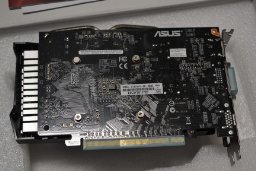
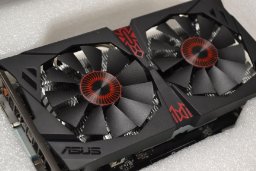
ASUS GeForce GTX 750Ti GDDR5 2GB Graphics Card GTX750TI-OC-2GD5
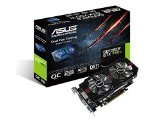
- Dual fans increase thermal efficiency with 2x greater airflow and 3x lower noise emissions
- Premium alloys in power delivery components defeat heat for cards that run 15% faster and last 2.5 times longer than reference
- 1150 MHz Engine Clock for better performance and outstanding gaming experience
- GPU TWEAK helps you modify Clock speeds, voltages, fan performance and more, all via an intuitive interface
- GPU TWEAK streaming let you share on-screen action in real time – so others can watch live as games is played
- OC edition, GPU clock higher than reference for smoother gameplay
- ASUS Dual Fan Cooling thermal design provides 2X greater airflow and runs 3X quieter
- Premium alloys in power delivery components dissipates heat for cards that run 15% faster and last 2.5 times longer than reference
- GPU Tweak provides real-time and intuitive tweaking.
The GTX750TI-OC-2GD5 is equipped with twin optimized fans carefully selected by engineers drive 2Xgreater airflow while maintaining 3Xquieter performance, combining enhanced cooling with a more pleasant gaming and computing environment. It’s exclusively-formulated alloy components boost performance by reducing power loss, enhancing durability, and achieving cooler operation. Choke concrete cores eliminate buzzing sound under full load while capacitors assure a 50,000-hour lifespan: equivalent to 2.5 times longer than traditional capacitors. The NVIDIA GPU Boost 2.0 technology is for intelligent monitoring of clock speed, ensuring that the GPU runs at its peak and the game is at its highest frame rate possible. It offers new levels of customization, including GPU temperature target, overclocking, and unlocked voltage.

List Price: $ 124.99
Price:


|
83 of 89 people found the following review helpful
 Kick Ass!,
This review is from: ASUS GeForce GTX 750Ti GDDR5 2GB Graphics Card GTX750TI-OC-2GD5 (Personal Computers)
The ASUS designed GTX 750ti is no doubt better than the Nvidia reference one. This card blew me away with how well it performs.
PERFORMANCE COOLING INSTALLATION OVERALL OPINION
50 of 53 people found the following review helpful
This ASUS GTX 750Ti is a massive upgrade over my old eVGA 9800 GTX+ Superclocked Video Card!,
Verified Purchase(What’s this?)
This review is from: ASUS GeForce GTX 750Ti GDDR5 2GB Graphics Card GTX750TI-OC-2GD5 (Personal Computers)
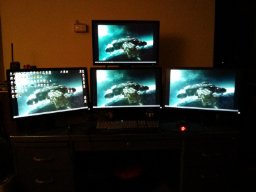
This is the perfect video card for tripple-lcd "surround-sound" gaming, with a 4th utility monitor!
I have this card setup as follows on my gaming pc: 1st DVI Port – Dell 24" LED/LCD @ 1920×1080 (3D Capable Port) I purchased a HDMI Female to DVI-D Male Adapter to affix to the DVI Input on the back of one of the Dell 24" Monitors. I used a standard HDMI Cable to connect that monitor to the 750ti’s HDMI output. This is a LOT cheaper than other video cards that would require you to use a DVI or DisplayPort Cable, so pick your video card carefully based on the outputs that you want! With this setup I can play compatible games at 5760×1080 Resolution, with the 4th utility screen being my Samsung 24" at 1920×1200 Resolution. The 4th Screen allows me to run useful background apps like Voice Communications, Music, Browser, Etc. to great success! This card is also using an average of 77 watts LESS power than the old eVGA 9800 GTX+ Superclocked that it replaced. Where I was running everything on the old card at minimum settings, I can now run EVE Online at Max Graphics Settings with HDR Enabled at 5760×1080 Resolution and maintain a SOLID 50 Frames Per Second. EVE Online can be a very demanding game when the gfx are maxed out, and this card is taking it like a champ! I Highly Recommend this card if you can sore it for 5.00 like I did!
18 of 18 people found the following review helpful
 An Itty-bitty Card from an Enthusiast’s Point of View,
Verified Purchase(What’s this?)
This review is from: ASUS STRIX GeForce GTX 750TI Overclocked 2 GB DDR5 128-bit DisplayPort HDMI 1.4a DVI-I Graphics Card (Personal Computers)
As I always do, I shall preface this review with the obligatory “Look! Here are my machine’s specs!” charade:
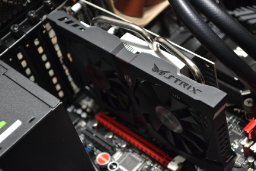
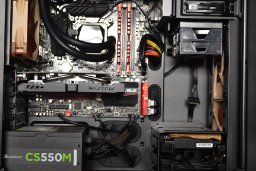
CPU: Intel i7-4790K (OC’d to 4.9 GHz) Regrettably I didn’t originally purchase this card for long-term use. I purchased it principally for temporary use in my machine to fill a void between my burnt out GTX 770 and the new Strix edition 970s from Asus, which are all seemingly sold out, much to my dismay. Until that fateful day in which I’m able to buy two of them (I want SLI) at a reasonable price, this is going to be my primary card. Since I’m stuck with this card for some time, I might as well benchmark it, right? I used a wide array of standardized benchmarking tools which include Cinebench, 3DMark11, AIDA64, Unigine Valley and Heaven, and some other obscure tools that proved the same numbers to me. They are as follows: UNIGINE HEAVEN (AAx2, Ultra, 1080p): I also tested a couple modern titles such as Farcry 3 and Batman Arkham Origins (even set at ultra, I got playable frame rates—over 30+ FPS) and stress tested the card with MSI Kombustor and AIDA64. In both of these tests the Strix 750 Ti never got one degree above 54 Celsius. Quite impressive and a testament to the Direct Cu inspired cooler design. It seems that even though I got a relatively low-end card, this minuscule piece of hardware packs a massive wallop; definitely something I would attribute to the highly efficient Maxwell architecture. I could not be more pleased. As I expected, however, the card gives and takes away. For those of us who are tweakers and like to overclock, this card is quite limited. As much as I wanted to take the card to the next level, I was limited by software to a core clock of 1337 and a VRAM clock of 5600. I can see why Asus did this, because they never bothered to put supplemental PCIe power connectors anywhere on the PCB, which leads me to my second complaint. An overclocking-capable card with no on-board PCIe power support is a sin in and of itself. I am convinced this card has tremendous overclocking potential, and Asus snuffed it out with this removal. What a shame. Not only does the card now lack the extra power but it also has a detrimental effect on the temps of my motherboard. Without any supplemental power to draw from, the card is forced to draw power from the PCIe lane on the motherboard. If you’ve maxed out the sliders in GPU Tweak as I have, you should expect to see over 50 degrees on your PCIe lane’s VRM. On my board (an ROG series board) this is not much of a concern, but for somebody else? I would be leery. My final complaint, which is very petty, is the installation booklet. If you are a first-time builder (which is primarily whom this card is targeted after) you might have some difficulty in the instructions—or lack thereof—seeing there are three pages’ worth in the included guide. But that is all. I think the biggest question this card answers is whom this card is for. In my opinion, this card is perfectly suited for those who are either building their first system on a budget, or for those who are looking to upgrade from a GTX 500 class card. For those who bought a prebuilt system and are mildly afraid of differentiating among the various types of power supply cables, this is a fantastic option for you as well. So far, I have enjoyed the experience that the GTX 750 Ti from Asus has brought me as a temporary card. For the people listed immediately above, it receives my highest recommendation. |


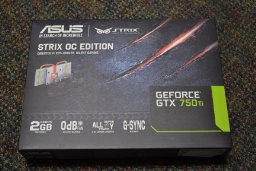
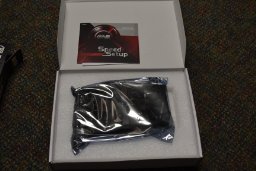


Kick Ass!,
PERFORMANCE
I could easily play very demanding games on normal/medium to high settings Here are some results.
DayZ Normal, No MSAA, FXAA high : average 47-58fps
Battlefield 4 High No MSAA : 40-60fps
Garrys Mod Ultra, 8x MSAA, High FXAA and 1080p (same with the rest) : Well over 100 fps was EASILY done by this card.
Those are just a few results, though I have MANY more in store.
COOLING
This card ran idle about 38 degrees, and yes that is celcius.
It ran under load at 60-70 degrees, and that’s on a REALLY hot day with high humidity.
Overall, it runs very quiet, and moves a lot of air.
INSTALLATION
Yes, it needs an external 6-pin PCI-E port, not just powered off the PCI Express rail, like the reference one is…
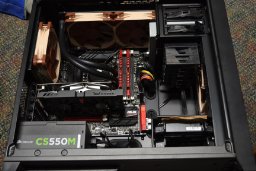
I had to, unfortunately, switch my power unit to one with the connector, which was easy, in and out, no big deal at all.
The placement of the connector isn’t very good, but keep in mind this card isn’t very large, so it could easily fit in a small form case. The card has one issue, and that it disposes air inside your case, which will jump your temperature a little, but as long as you have decent, 1000rpm+ fans, this is easily worked around. I would’ve liked to see DisplayPort options as well, because that’s what my monitor sports.
OVERALL OPINION
This card is incredible. You can take a very modest, mid-range PC (350-600 dollar range) and turn it into a gaming READY platform, not a very powerful machine that can play every game at 1080p on ultra, no that won’t happen.
But paired with 8GB of DDR3 RAM and an AMD A8-6500 quadcore CPU, it performs excellently.
Windows 8 compatibility? I have no idea, my machine runs Windows 7.
I highly recommend this card for someone wanting to crank up their cheap desktop PC performance with just a simple install of a card.
Was this review helpful to you?

|This ASUS GTX 750Ti is a massive upgrade over my old eVGA 9800 GTX+ Superclocked Video Card!,
I have this card setup as follows on my gaming pc:
1st DVI Port – Dell 24″ LED/LCD @ 1920×1080 (3D Capable Port)
2nd DVI Port – Dell 24″ LED/LCD @ 1920×1080 (3D Capable Port)
HDMI Port – Dell 24″ LED/LCD @ 1920×1080 (3D Capable Port)
VGA Port – Samsung 24″ LCD @ 1920×1200 (2D Capable Port)
I purchased a HDMI Female to DVI-D Male Adapter to affix to the DVI Input on the back of one of the Dell 24″ Monitors. I used a standard HDMI Cable to connect that monitor to the 750ti’s HDMI output. This is a LOT cheaper than other video cards that would require you to use a DVI or DisplayPort Cable, so pick your video card carefully based on the outputs that you want!
With this setup I can play compatible games at 5760×1080 Resolution, with the 4th utility screen being my Samsung 24″ at 1920×1200 Resolution. The 4th Screen allows me to run useful background apps like Voice Communications, Music, Browser, Etc. to great success!
This card is also using an average of 77 watts LESS power than the old eVGA 9800 GTX+ Superclocked that it replaced. Where I was running everything on the old card at minimum settings, I can now run EVE Online at Max Graphics Settings with HDR Enabled at 5760×1080 Resolution and maintain a SOLID 50 Frames Per Second. EVE Online can be a very demanding game when the gfx are maxed out, and this card is taking it like a champ!
I Highly Recommend this card if you can sore it for $135.00 like I did!
Was this review helpful to you?

|